My Digital Audio: A Nurse’s take on the Safety of Healthcare Workers amidst the COVID-19 Pandemic

Listen to my podcast interview about the current state of safety for healthcare workers amidst the COVID-19 pandemic: https://soundcloud.com/whatistrill/jms-315-interview-fixed

Hello everyone! I hope everyone is say and in good health during these trying times.

This audio represents my digital self, as it is an interview with a family member that I have a close personal relationship with, my dad. Additionally, this audio is a representation of my virtual self, in that is an interview with an expert healthcare worker during what is surely one of the most volatile global situations I have experienced during my young life.

The first principle of audio production I followed was the sound check. I began by prompting my subject to speak. I then referenced the VU meter to see the loudest points of my subjects speech, which I then edited in post production to keep a consistent speech level throughout the podcast’s entirety (Costello, 401).

The second principle of audio production I followed to create my mini-podcast was related to the equipment. Specifically, I employed the use of analog-to-digital converter microphone, or a USB microphone. This allowed me to pick up clear audio without any outside noise interfering (Costello, 394).
Blog Post Three: Current Reflections

Hello everyone! This week in my journey to becoming a multimedia professional, I began studying audio. While going through my lectures and doing my readings some things jumped out to me about audio that I had not previously considered. In this day and age, microphones are seen just about everywhere, but I had not put much thought into how these devices work. It turns out microphones perform their functions through a process called transduction. Transduction is the process of converting an acoustical waveform signature’s sound into an electrical voltage signal that represents the amplitude and frequency imprint of the recorded sound. This is the process that has allowed for audio to become such a prominent medium in today’s world.

While focusing in solely on the medium of audio it became apparent to me that, while media is increasingly converging, audio by itself has become increasingly important in the modern media landscape. As radio in its traditional sense has faded away, the podcast has made its rise to popularity. The market for podcasts has grown exponentially over the last several years, and it is now in the best interest of every media professional to have a strong grasp on audio in general and how it pertains to podcasts specifically.

Until next time everyone!

Digital Image Assignment: Me, Myself & I

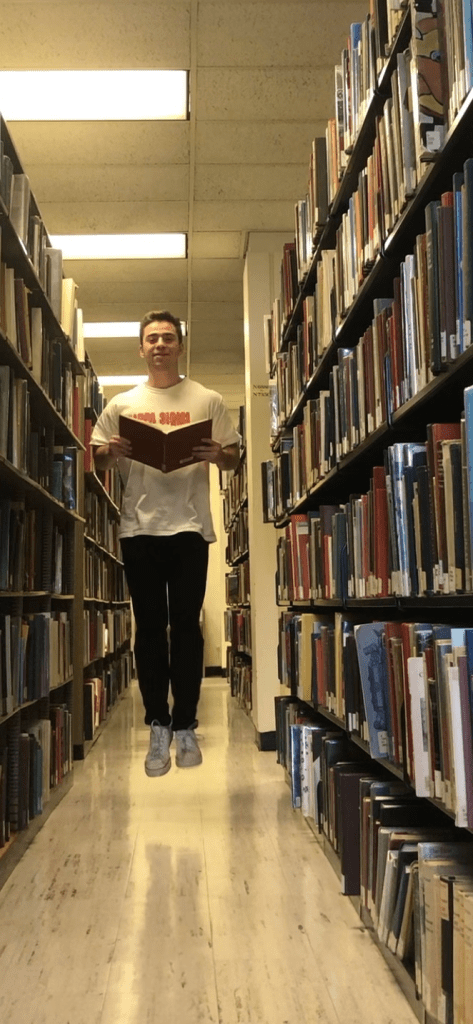
The image above pictures me in my favorite study spot, the fourth floor table section of the love library. The image represents my digital self as it displays me in my natural habitat this Spring semester. Due to my heavy workload this semester, I’ve spent a large portion of my free time studying and working on my assignments. As an individual, I’ve found it easier to commit myself to my school work in a setting like the library, as it limits the outside distraction that I would be otherwise exposed in a setting such as my own bedroom. Putting myself in an environment conducive to focus has been one of my key goals to academic success throughout college.

One of the digital media principles that this image focuses on is depth of field. Depth of field is defined by Multimedia Foundations: Core Concepts for Digital Design, as, “the area of a scene in front of and behind the main subject in focus,” (Costello, 316). Specifically this image presents a great depth of field, meaning noticeable portions of the majority of the scene are sharply defined. Additionally, this image focuses on the rule of thirds-composition. The rule of thirds composition states that the main subject of the image should be centered on one of the points in which the grid lines meet on a digital camera, as this is where the viewers eyes naturally go.