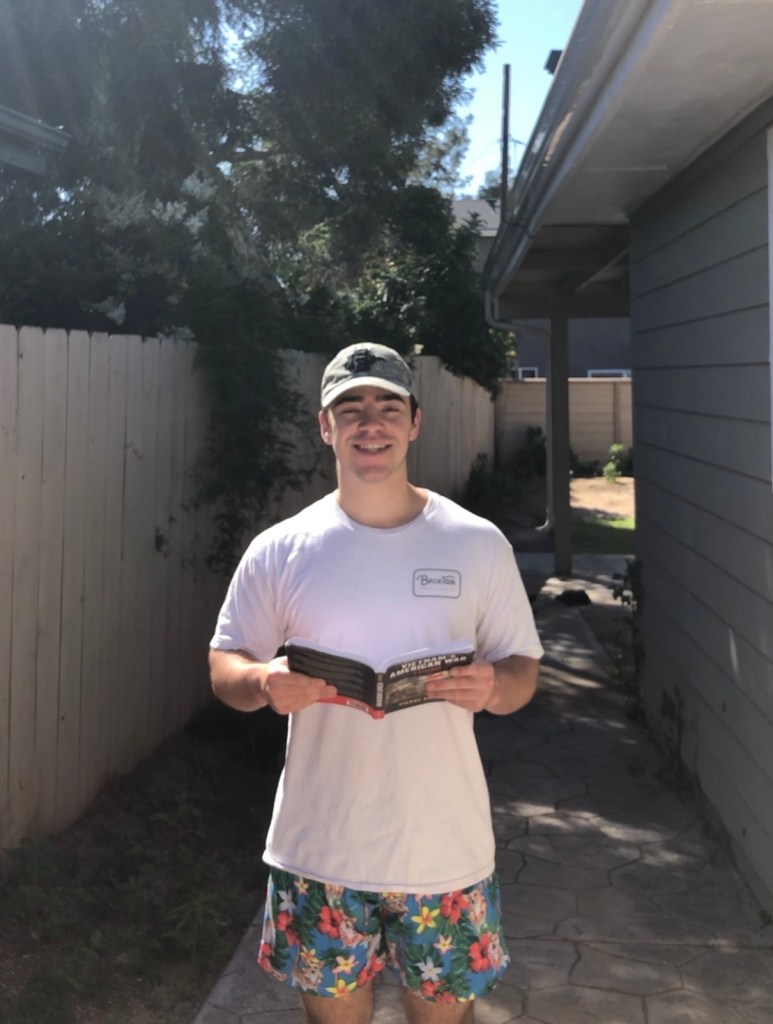
The image above pictures me in my new study spot, my own home. The image represents my digital self as it displays me in my new habitat this Spring semester. Now that San Diego State has moved all of its classes online, I’ve had to adjust to doing school work at home. Putting myself in an environment conducive to focus, such as the library has been one of my key goals to academic success throughout college, but due to my new circumstances, I’ve had to adjust to working at home.
One of the digital media principles that this image focuses on is depth of field. Depth of field is defined by Multimedia Foundations: Core Concepts for Digital Design, as, “the area of a scene in front of and behind the main subject in focus,” (Costello, 316). Specifically this image presents a great depth of field, meaning noticeable portions of the majority of the scene are sharply defined. Additionally, this image focuses on the rule of thirds-composition. The rule of thirds composition states that the main subject of the image should be centered on one of the points in which the grid lines meet on a digital camera, as this is where the viewers eyes naturally go.
______________________________________________________________________________
Listen to my revised podcast interview about the current state of safety for healthcare workers amidst the COVID-19 pandemic:
This audio represents my digital self, as it is an interview with a family member that I have a close personal relationship with, my dad. Additionally, this audio is a representation of my virtual self, in that it is an interview with an expert healthcare worker during what is surely one of the most volatile global situations I have experienced during my young life
The first principle of audio production I followed was the sound check. I began by prompting my subject to speak. I then referenced the VU meter to see the loudest points of my subjects speech, which I then edited in post production to keep a consistent speech level throughout the podcast’s entirety (Costello, 401).
The second principle of audio production I followed to create my mini–podcast was related to the equipment. Specifically, I employed the use of analog-to-digital converter microphone, or a USB microphone. This allowed me to pick up clear audio without any outside noise interfering (Costello, 394). Additionally, I have revised this podcast to feature intro and outro music so that the podcast itself is more pleasing for the listener.
______________________________________________________________________________
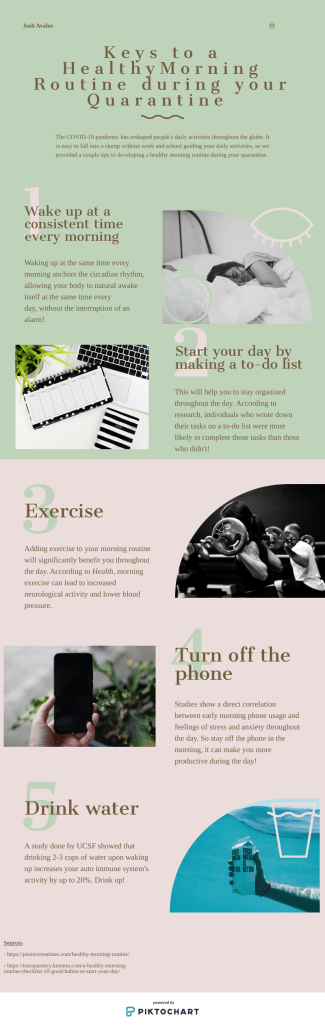
During the COVID-19 Pandemic, I found that my own personal routine had been thrown out of rhythm. I had previously structured my days based upon class time, meeting times, and study time. Now that SDSU has gone completely online, my class and meeting scheduled has become more or less flexible. The first week of quarantine, I found myself wasting my morning by sleeping in, and spending too much time scrolling through social media once I finally woke up. Rather than letting the new circumstances I found myself in get the best of me, I decided that this would be the perfect time to develop a new morning routine. Above is an infographic that lists my personal tips to develope a good morning routine, and the benefits of each habit.
For the infographic, I followed the principle of raster image formatting by downloading my image as a PNG file. The PNG file was conducive to displaying a graphic with a multitude of colors (Costello, 279). I also made use of the design principle of negative space. I made sure my infographic had plenty of negative space in order to let the image breathe, allowing readers to not become too overwhelmed by the information being presented (Costello, 118). Additionally, I have revise this assignment to include less text, as the text previously provided too much clutter on the screen.
______________________________________________________________________________
My Digital Self
My digital self is a virtual, outward expression of my constantly developing and changing circumstances. I anticipated this spring semester to be one of my most difficult academic challenges to date. I was right in believing this, but I did not foresee my environment being changed so quickly by the COVID-19 pandemic. My initial digital assignment, along with my recently revised digital assignment, perfectly reflect this academic challenge and my rapidly changing environment. When I first posted my digital assignment, I was pictured in what I would call my element. That is the fourth floor love library with a book in hand; this was the spot I called home when it was 11:00 p.m. and I was running on fumes. In my revised digital assignment, my environment has shifted, as I’ve been forced into the isolation of my home, but what remained constant was my book in hand, as my school work did not slow as a result of COVID-19.
By the time I reached the digital audio assignment, the world around me had shifted, and I found myself back at home interviewing my father, a nurse battling COVID-19 on the front lines. Similarly, my infographic assignment reflected my personal attempt to adjust with my new environment. I had, at the time, been looking for new routines to keep myself driven and motivated under the changing circumstances. The infographic assignment was a visual that reflected a new habit that I was attempting to develop in order to adjust.
I would have never predicted my semester to go this way, and all three of my assignments reflected my environment and personal habits changing. These assignments are my digital self, a virtual, outward expression of my constantly developing and changing circumstances.
The most important way JMS 315 has helped me understand digital media principle designs is through the creation of my own digital content. Prior to this class, I had very limited experience with podcasts and absolutely no knowledge of how to create something like an infographic. Through lectures and class reading I was able to understand the principles that define these pieces of digital content, and then apply them to my own creation of the content. This allowed me to see theoretical principles come into fruition, providing an invaluable lesson in digital content creation.
The design principles that resonated with me the most were the five design principles of an infographic; it’s truthful, functional, beautiful, insightful, enlightening. I’ve always found infographics to be super helpful in developing my understanding of a topic, but when I initially came around to making my own. I found myself adding unnecessary information and visual aspects. I sat on my rough draft of the infographic for a day, and when I returned to edit it, I went through each word and graphic and asked myself, “Is this furthering at least one of the five design principles of an infographic?” If the answer was no I cut it out, and what I was left with was my final infographic that I now have printed up on my own bedroom wall to help maintain consistency in my new morning routine.
My Assignments
When creating my digital image assignment I found myself stuck at ground zero, as I had no idea how to come up with a single image that would represent who I was digitally, this was the most challenging moment of the assignment. At the time I was sitting with three friends in the love library doing homework. I was speaking to them about the assignment when one of my friends made the remark that we don’t really do anything except sit in the library all day. Immediately I realized that the best digital image would be me in the library, which ended up being the setting for the picture. For the picture I used my iPhone camera because of its simplicity and convenience. The most enjoyable moment of the assignment was jumping up and down several times until my friend could get a picture of me in a still frame that made it look as if I was hovering over the ground.
During the time I was creating my audio assignment, California had just issued its stay at home orders, and my home town, Fresno, CA, had gone on lockdown. I made the journey back home to be with my family during the unprecedented circumstances. At the time a lot of media attention was being focused on frontline healthcare workers. Being that both of my parents are registered nurses, I figured I would sit down with my dad and talk about his opinion on the safety of frontline healthcare workers amidst the COVID-19 pandemic. For the assignment I used a Blue Snowball USB microphone for clear audio, and Garageband to end and export the audio, which was a convenient application to use as I already had it downloaded on my mac and had prior experience using it. The most challenging moment of the assignment came about during its recent revision. Adding the music to the audio file was easy, but figuring out how to fade the music in and out at the appropriate time was difficult. The most enjoyable moment of my assignment was watching my dad listen to his own voice in a podcast from his phone. He thought it was the coolest thing ever.
While creating my infographic assignment, I also used my new circumstances that came about as a result of the COVID-19 pandemic for inspiration. At the time I was struggling to get myself going in the morning without the motivation of making it to class on time. I began searching the web for help to create a new morning routine that would work for me. The tips I pulled from this search ended up being the base for my infographic assignment. To make the infographic assignment I used the website Piktochart. I found Piktochart to be very user friendly, and I thought its design templates to be much better than Canva’s. The most challenging aspect of the assignment was finding research that would back the morning routine tips I was promoting. Finding the source material took a couple hours. The most enjoyable aspect of this assignment was sitting down and really thinking through the development of my own personal routine. Since I created this infographic, I’ve been to the habits I outlined, and they’ve paid dividends.
 Josh Avalos' Blog